
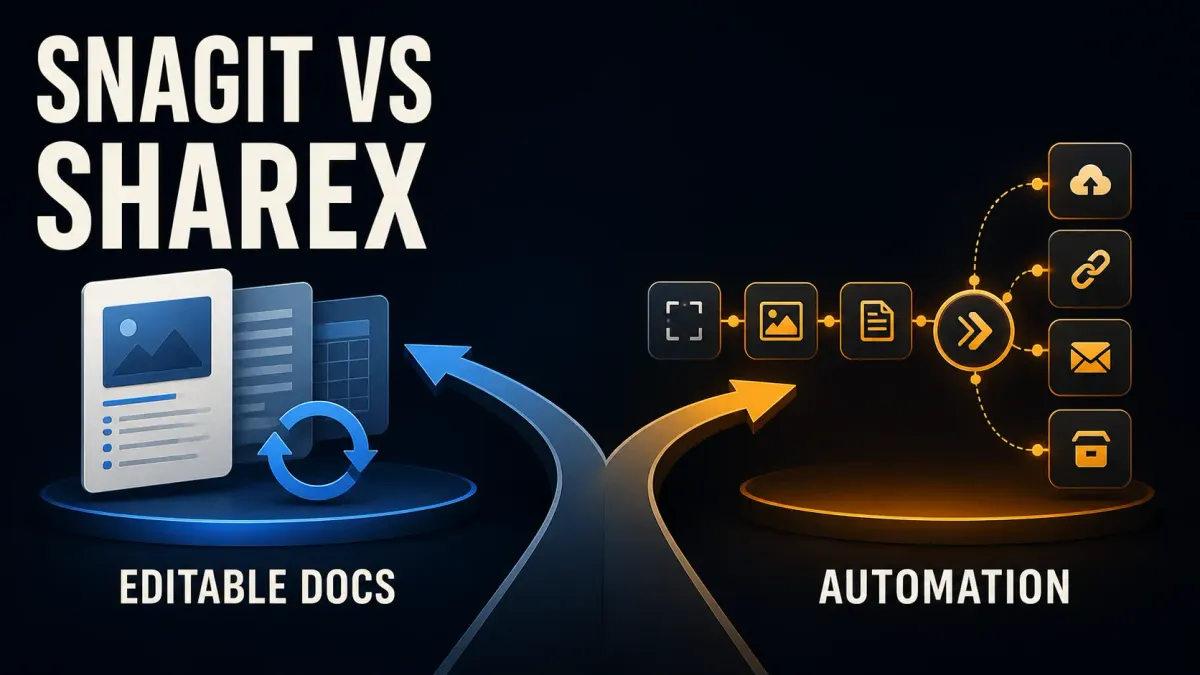
Choose ShareX for free Windows capture with configurable save, edit and upload tasks. Choose Snagit if you need the same capture product on Windows and Mac, editable SNAGX sources, or automatic visual-guide creation. Both annotate screenshots, capture scrolling content, extract text and record video.
ShareX's current editor is substantial. Calling it a basic alternative misses the real question: do you need a finished image today, a guide to revise later, or a repeatable capture workflow?
Checked September 13, 2026 using vendor documentation and ShareX's stable release notes. This is a research-based comparison, not a speed or reliability benchmark. The diagrams explain workflows; they are not exact application screens.
Snagit vs ShareX at a glance
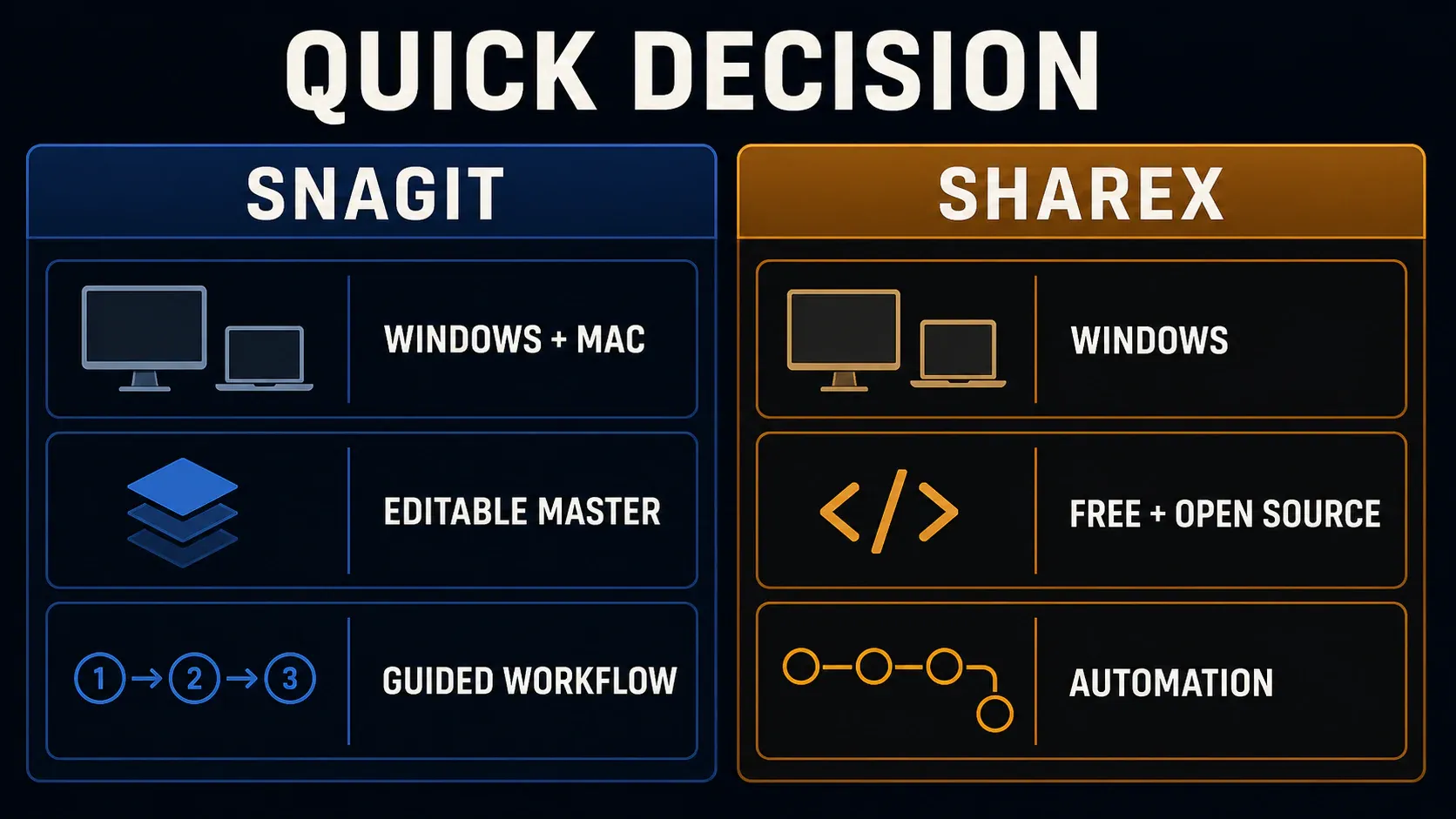
The diagram describes useful reasons to choose each tool, not exclusive capabilities. ShareX also edits images; Snagit also has capture presets.
| Decision | Snagit | ShareX |
|---|---|---|
| Price | Paid annual subscription; trial available | Free, open source; no paid capture tier |
| Desktop platform | Windows and macOS | Windows |
| Image editing | Annotations, text tools and reusable SNAGX sources | Modern editor with annotations, effects and numbered markers |
| Long screenshots | Scrolling capture | Scrolling capture |
| Procedures | Step Capture builds a numbered visual guide | Capture images and assemble the procedure yourself |
| Repeated tasks | Presets and editor workflow | Hotkey workflows, after-capture tasks, actions and custom uploaders |
| Video | Recording with audio and basic trimming | FFmpeg-based recording and GIF; configurable audio source |
| Support | Commercial vendor support | Project documentation and community support |
For ordinary Windows screenshots with arrows, try ShareX before paying. For a mixed Windows/Mac team or frequently revised instructions, evaluate Snagit with one of your actual documents. The screenshot software comparison covers other choices.
Price and platform can settle the choice
The ShareX project is free under GPL-3.0 and does not require an account for its core capture tools. Third-party hosting or an optional AI provider can have its own costs. Use the project's linked downloads rather than a similarly named download site.
The Snagit Individual store displayed €39.56 per user/year, billed yearly, in the regional response checked September 13. Your currency and checkout total can differ. Individual subscriptions are non-transferable; use the pricing and license guide for business purchasing rather than treating an individual subscription as a shared seat.
ShareX is a Windows application, not a native Mac alternative. Its stable release history lists 21.0.0 on July 3, 2026; current releases require 64-bit Windows 10 or later. Snagit's dedicated requirements page covers Windows and macOS. It currently lists macOS 15 and 26, while the store still says 14+. Check the requirements for your exact Snagit version before installing on an older Mac.
Editing now and revising next month are different jobs
ShareX's modern image editor supports text, arrows, speech balloons, shapes, numbered steps, crop and effects. You can adjust annotation objects while editing. Recent releases made this editor the default; the legacy editor remains selectable in Task settings → Tools. An old review of the legacy interface does not describe the current default.
Snagit's SNAGX source format keeps supported text and drawn objects editable after saving. Keep that source if a label may change. PNG and JPEG delivery copies flatten the annotations.
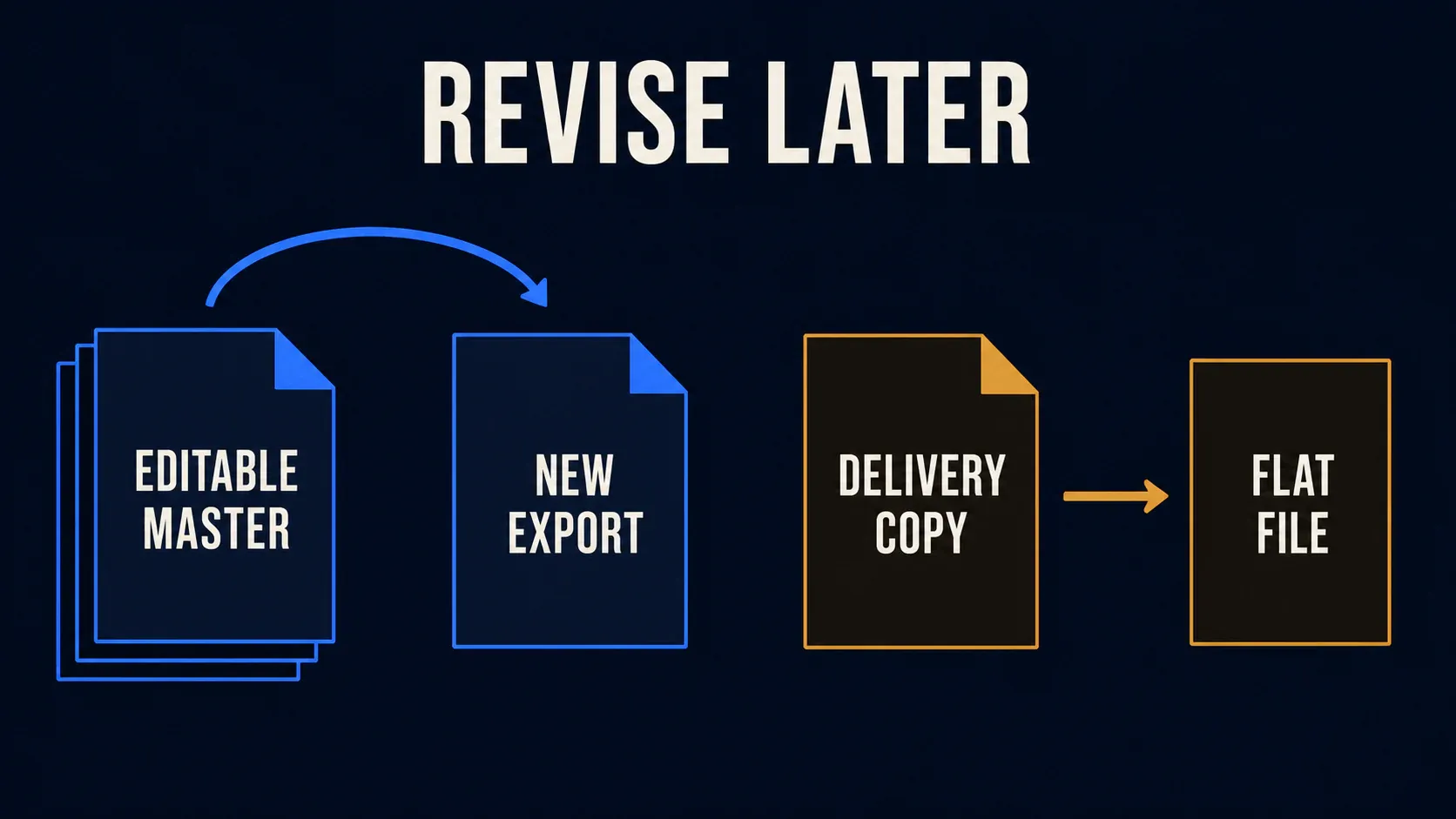
The same warning applies to a ShareX PNG or JPEG: reopening it does not restore separate arrows and text objects. ShareX's documentation describes editing and exporting, but does not establish a SNAGX-equivalent persistent annotation project. Do not mistake its SXIE image-effect configuration for an editable screenshot master.
Try a concrete revision: save a screenshot with a callout, close it, then reopen it and move only the callout. This checks your actual file format and workflow. Snagit's Editor guide covers working with the source instead of repeatedly editing a flattened export.
Both products have ways to find old captures. ShareX added tags and favorites to its history in version 18. A searchable collection alone is not a reason to assume you need Snagit; check whether you can retrieve and revise the file you need.
Scrolling capture, OCR and numbered instructions
Both can make a long screenshot. The ShareX scrolling guide explains why fixed headers, animation and hover effects can prevent clean stitching. Select the moving content and inspect the joins and final lines. Snagit also needs checking on the target page; its scrolling capture guide covers the capture workflow. Neither tool earns a universal reliability claim from a feature checkbox.
For text extraction, ShareX OCR uses the OCR languages installed in Windows. Snagit's text tools can extract text and support image-text editing. Check names, numbers and punctuation against the image before using the result.
Snagit's Step Capture creates a numbered visual guide from a process. ShareX's Step annotation tool numbers markers on an image; that is not automatic multi-step procedure capture. For recurring SOPs, compare the effort to capture, arrange and later update a complete guide. The documentation tools comparison covers this broader job.
Automation: be explicit about what happens after capture
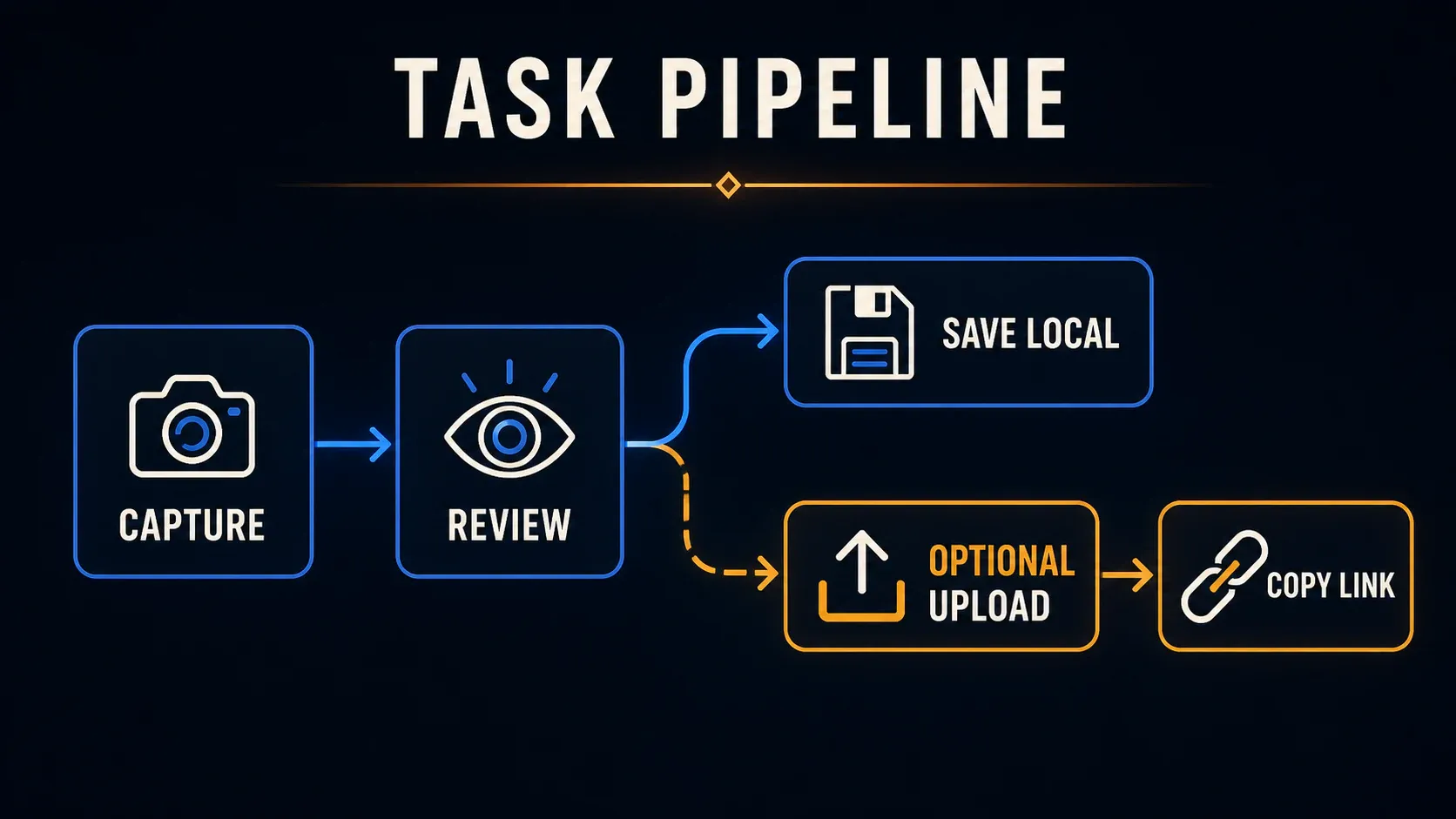
ShareX can use one hotkey for a local image and another for a reviewed upload. Configure the intended after-capture and after-upload tasks separately. Its editor's Continue action runs the remaining configured tasks; it is not an unconditional save-only command.
For external processing, ShareX Actions pass a saved image to another application. The documented setup requires Save image to file and Perform actions. This can suit an approved image converter or a repeatable processing step, but configuration and maintenance still belong to your team.
Watch the command line. The official arguments treat a bare file path or URL as an upload request. Use the documented -ImageEditor action when opening a file for editing; do not assume passing a path simply opens an editor. Test scripts with non-sensitive files.
A user reported an edit-then-save problem in ShareX issue 8567 on version 20.0.4. That is one version-specific report, not evidence that 21.0.0 generally fails. It is a useful reminder to test the complete capture → edit → save sequence, not just whether the capture button works.
Screen recording and audio
ShareX's recording guidance covers FFmpeg-based video and GIF capture, with a configurable audio source. Check the selected device and output settings with a short recording. GIF has no sound. Do not assume a successful video file proves the microphone was recorded.
Snagit provides recording with audio and trimming. It suits short explanations; it is not the full multi-track Camtasia Editor. The Snagit recording guide covers setup. For a production timeline rather than a quick capture, choose a dedicated editor separately.
Privacy: check destinations and the actual shared file
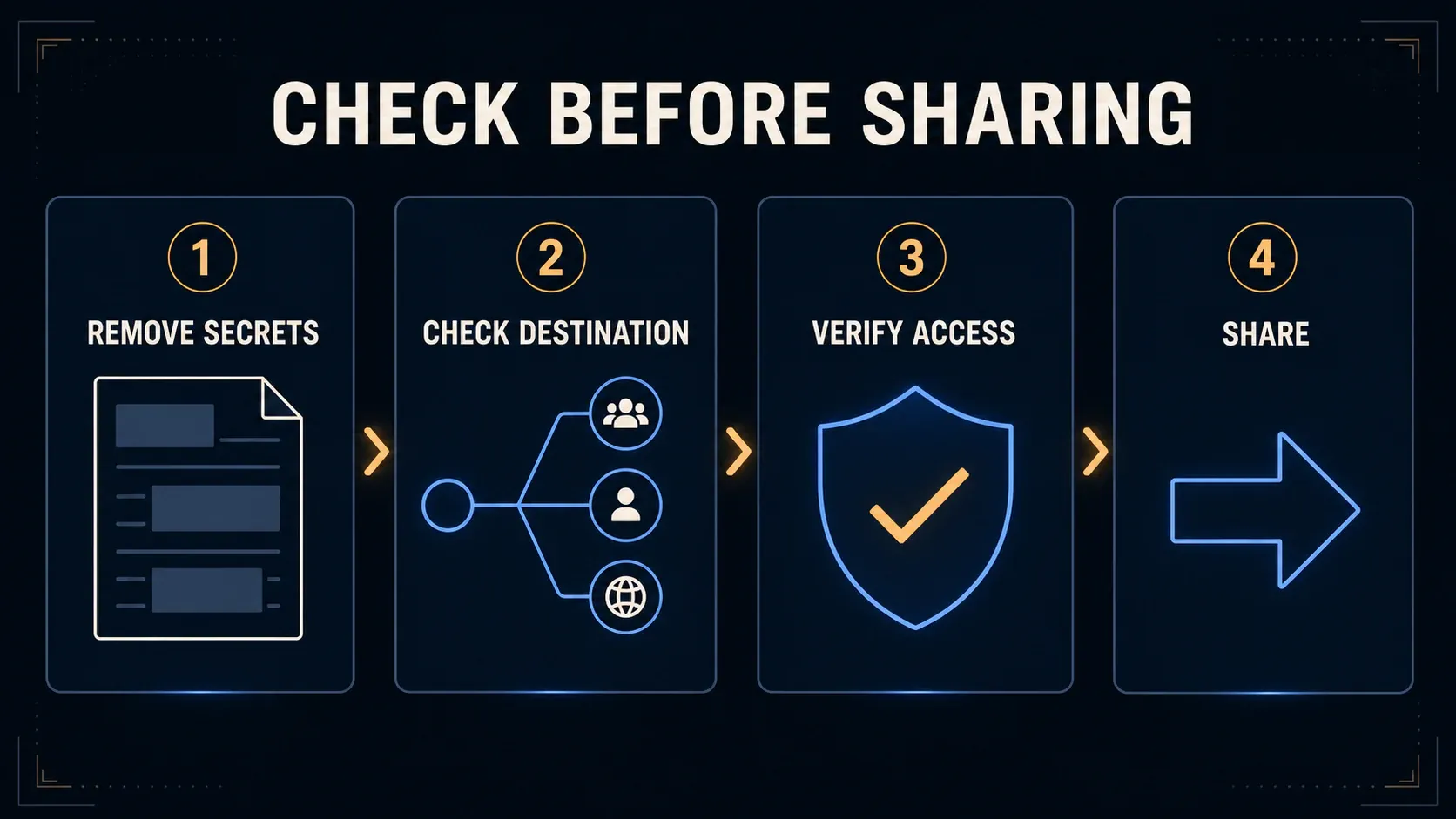
Remove sensitive content from the delivery image, export it, and inspect that exported file. A cover that can be moved in an editable source is not permanent removal. Keep originals restricted; the redaction guide explains why blur alone is not a safe default for secrets.
ShareX disabled automatic upload by default for new installations in version 19.0.1. Do not assume an upgraded installation has the same settings. Check the active tasks and destination. Its optional Analyze image feature is separate from OCR: it requires an API key and may send content to your selected external AI provider. Disabled by default does not mean safe to ignore after enabling it.
Importing a custom SXCU uploader can change the active destination. Inspect its endpoint and authentication fields before importing or sharing it. A configuration file can contain credentials. Never test an unfamiliar uploader with confidential content.
Snagit's local sources do not make every sharing action local. Current Windows release notes and Mac release notes say images sent to Camtasia Online use SNAGX, including text, cursor and other capture information. That differs from sending a reviewed flat export.
For managed computers, ShareX documents silent installation and a DisableUpload policy. TechSmith provides deployment preparation and connected-feature controls. Neither removes the need for an approved storage location, patching and an owner for configuration. Choose commercial support if your team needs that support route; do not assume free software cannot be managed.
Snagit vs ShareX FAQ
Is ShareX a good free alternative to Snagit?
Yes, for Windows screenshots, annotation, scrolling capture, OCR and configurable tasks. Snagit is worth evaluating when you need Mac support, editable SNAGX sources or automatic visual-guide creation.
Does ShareX work on Mac?
The ShareX desktop application is for Windows. Snagit supports Windows and macOS, subject to the requirements of the installed version.
Can ShareX edit screenshots?
Yes. Its modern editor supports text, arrows, shapes, numbered markers and effects. A saved PNG or JPEG does not retain those annotations as separate editable objects.
Does ShareX automatically upload screenshots?
Automatic upload is disabled by default for new installations from version 19.0.1. Existing settings can differ. Check the active workflow, upload tasks and selected destination before capturing private content.
Can both tools take scrolling screenshots?
Yes. Results depend on the page or application. Fixed elements and moving content can interfere with stitching, so inspect the complete result.
Is Snagit Step Capture the same as ShareX Step annotations?
No. Snagit Step Capture builds a numbered guide from a process. ShareX Step annotations place numbered markers on an image; they do not automatically assemble a multi-step procedure.
Which should a Windows team choose?
Start with ShareX if its free capture and editing tools meet the job and someone can maintain the configuration. Evaluate Snagit when source-file revisions, guide creation or commercial support justify the subscription. Test one real capture and one later revision before standardizing.