
Open Snagit > Settings > Capture > Fix Capture Permissions, then check the permission for the task that fails. Screen capture, microphone, camera and automatic scrolling use different controls. A blank image or silent recording is a reason to check access, not proof that access is the cause. Save unfinished work before restarting Snagit.
Checked September 13, 2026. This guide uses current Apple and TechSmith documentation, including Snagit Mac 2026.3.2. It is not a hands-on test of your Mac. Current Snagit 2026 requires a supported Sequoia 15 or Tahoe 26 system; older releases and permission labels differ.
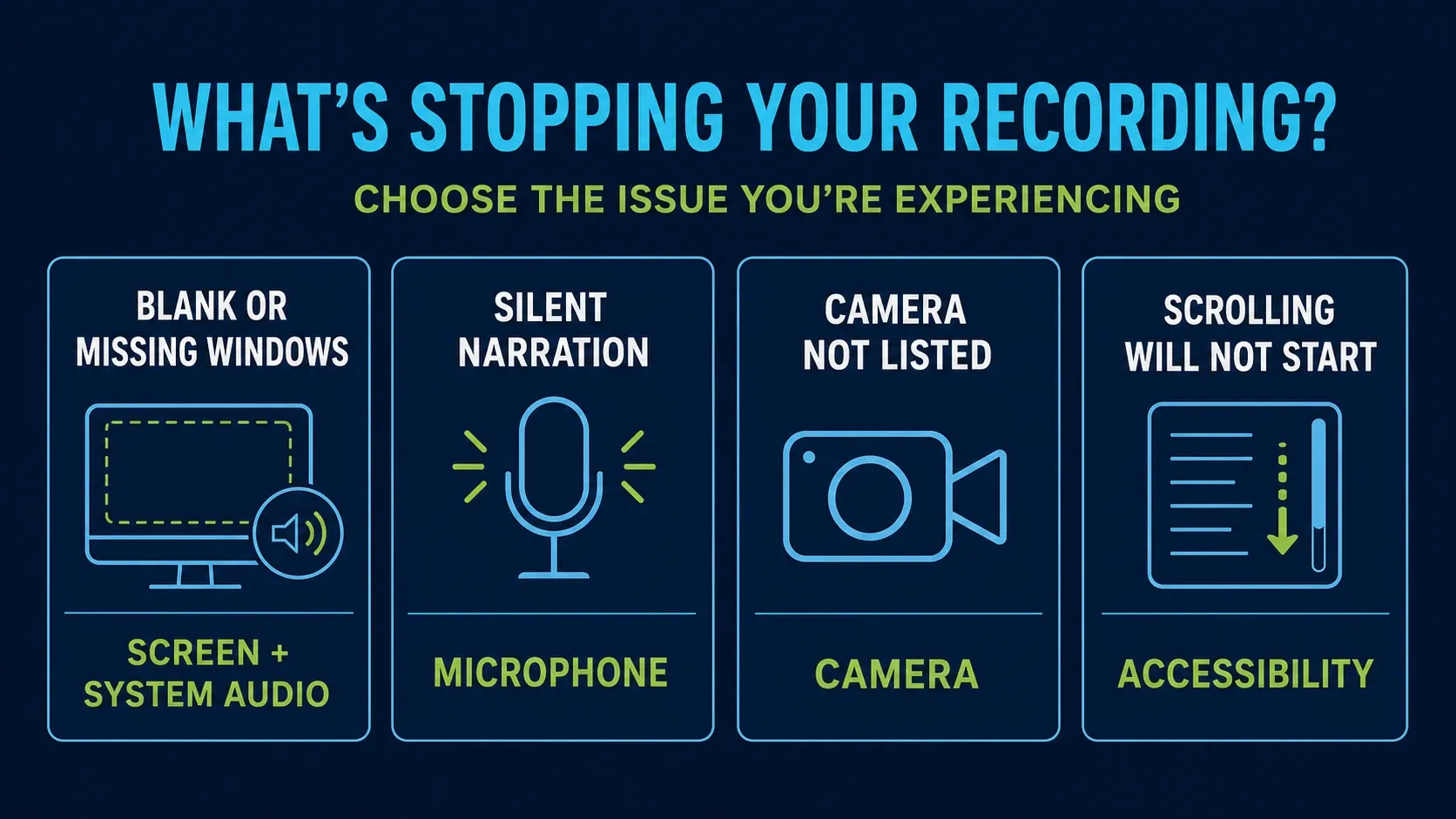
Match the symptom to the permission
Start with one failed capability. Leave unrelated permissions unchanged and use a harmless local test after each change.
| Symptom | Check | Test |
|---|---|---|
| Blank or missing window content | Screen & System Audio Recording | Capture a plain local text window |
| Computer sound missing | Screen & System Audio Recording, plus Snagit’s system-audio switch | Record local playback with microphone off |
| Your voice missing | Microphone, selected input and recording switch | Record one spoken sentence |
| Webcam missing | Camera, selected device and compatibility | Preview or record the intended camera |
| Automatic scrolling will not start | Accessibility for Snagit and SnagitHelper | Try a simple scrollable page |
| Permission locked or reverting | Possible device-management restriction | Ask IT to check the installed app and policy |
Do not test on protected video, customer records or a confidential dashboard. A successful local test establishes only that the tested task worked. It does not prove that every application, device or protected source can be captured.
Start with the built-in permission check
Save your open captures and stop any recording first. On a managed Mac, follow your organisation’s access policy rather than changing locked controls.
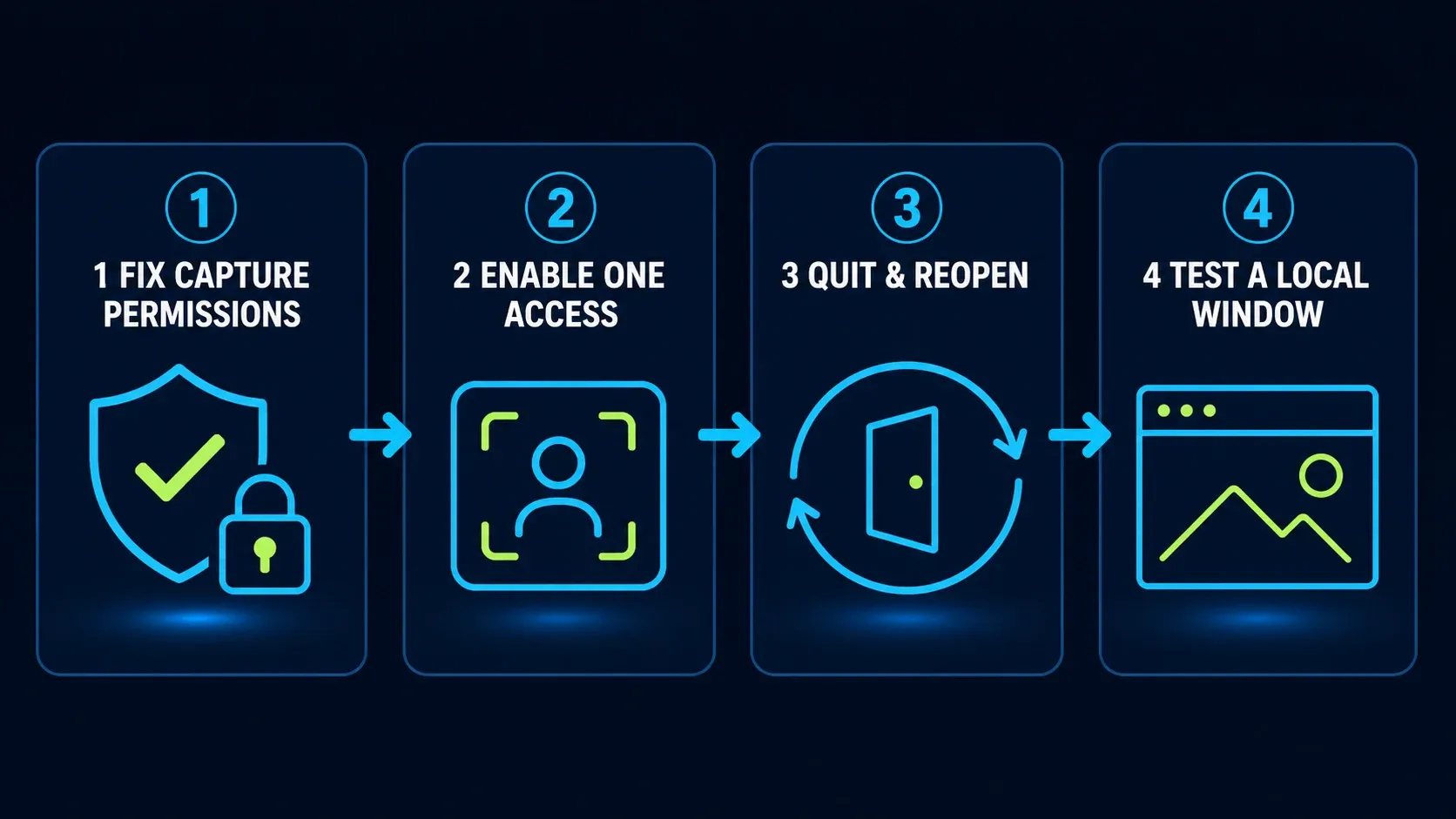
- Open Snagit and choose Snagit > Settings > Capture.
- Select Fix Capture Permissions.
- Select Enable or Edit System Permissions for the capability you need.
- In macOS Privacy & Security, approve the matching Snagit permission only if you trust this installed app and are authorised to change it.
- Choose Quit & Reopen if prompted, or quit and reopen Snagit after saving your work.
- Capture a plain local window or record a harmless local source. Inspect the result before changing another setting.
TechSmith’s Mac permission procedure explains the panel and restart requirement. Some changes do not take effect until the app restarts. If the test works, stop; there is no reason to reset other permissions.
Fix blank captures and missing windows
In System Settings > Privacy & Security > Screen & System Audio Recording, check the entry for the Snagit copy you run. Apple’s screen and audio access guide distinguishes combined screen/audio access from audio-only access. Audio-only permission does not grant screen capture.
After saving work, quit and reopen Snagit and capture a plain local window. If normal windows work but one protected app remains blank, investigate that target rather than granting more access. For desktop-only captures, TechSmith also specifies SnagitHelper screen access when using Snagit 2022 or earlier. Do not apply that older-release instruction to every current permission category.
If Snagit is missing from the screen-access list, use its permission panel or start a capture to request access. Apple also documents an Add button below the list. Select the actual installed app, not an unrelated copy or installer. Older macOS versions may call this category Screen Recording.
If local windows still fail after the permission and restart checks, use the Snagit black-screen guide for other causes. A recurring approval prompt alone is different: TechSmith documents a periodic screen-access prompt for SnagitHelper 2024 on Sequoia. That older notice is not proof of a broken permission database, nor a promise that every current release uses the same prompt interval.
Fix silent system audio without installing an old component
System audio is sound from the Mac; microphone audio is an input such as your voice. Check the relevant screen/audio access, then turn on Record System Audio in Snagit’s video capture settings. Test local playback with the microphone off so you know which channel you are hearing.
For current supported Snagit on macOS 13 or later, the legacy audio component is unnecessary. Version matters: TechSmith’s Ventura guidance identifies native audio in 2022.2.3 and 2023.0.1; 2023.0.0 still used the older workflow. Do not install an old extension or change Recovery security settings as a routine fix for Snagit 2026.
Install the latest available update within the Snagit release your Mac and licence support, then repeat a short local test. The Mac release history lists 2026.3.2, September 2. It also removes the microphone-options button from the toolbar during recording, so choose your input before recording instead of hunting for an older in-recording control.
If only one source is silent, try a different local source before a permission reset. The Snagit audio troubleshooting guide covers recording switches, devices and playback separately.
Fix a silent microphone
Save work and quit Snagit. Open System Settings > Privacy & Security > Microphone, allow Snagit if appropriate, then reopen it. Apple’s audio-input instructions apply to built-in microphones, USB microphones and audio-interface inputs.
Before starting a video, enable microphone recording and select the intended input. TechSmith’s sample-buffer troubleshooting starts with that device selection. Record one sentence and listen back. If another app records correctly, the microphone can work in that app; Snagit’s own permission, input selection and compatibility still need checking.
Recheck the selected input after reconnecting a headset, dock or USB microphone. Do not enable Camera or Accessibility just to repair microphone recording. They grant different capabilities.
Fix a missing camera
Open System Settings > Privacy & Security > Camera and check Snagit. Apple’s camera-access guide says this list contains apps that have requested access. If Snagit is missing, use its camera feature to trigger a request, then reopen the app after any required approval.
Select the intended camera in Snagit. Close another camera app only after saving its work or ending your session, then retest. For an external camera, check its connection and try a direct Mac port if appropriate. These are isolation checks, not proof that another app or hub caused the failure.
TechSmith’s camera compatibility table lists tested internal webcams and selected Logitech models through Snagit 2025, not 2026. It marks virtual cameras such as XSplit VCam and ManyCam unsupported. Do not extend that older test matrix into a guarantee for every current device or capture card.
Photo Booth or FaceTime working does not establish Snagit’s permission: Apple’s built-in camera apps have automatic access. If Snagit still cannot list a working device, record its exact model, connection and software version for support.
Give Automatic Scrolling its separate Accessibility access
TechSmith’s Automatic Scrolling procedure uses Snagit > Settings > Capture > Fix Capture Permissions. Under Scrolling Capture, select Enable, then Enable Scrolling Capture and Open Settings when offered. Approve the requested Accessibility entries for both Snagit and SnagitHelper.
Check those entries in System Settings > Privacy & Security > Accessibility. Reopen Snagit if needed and try a simple scrollable page before a complex application. Screen access and Accessibility are separate checks.
Apple explains that Accessibility lets an app control your Mac. Grant it only to the trusted installed app for a feature you use. Do not turn on every optional permission merely to capture a normal screen region.
A stitching failure after scrolling starts can be a content or capture-method issue. The scrolling capture guide covers those alternatives. Snagit Mac 2026.3.2 specifically fixes Automatic Scrolling in Microsoft Edge, so check the installed version before resetting permissions for that case.
Check for an old or duplicate Snagit copy
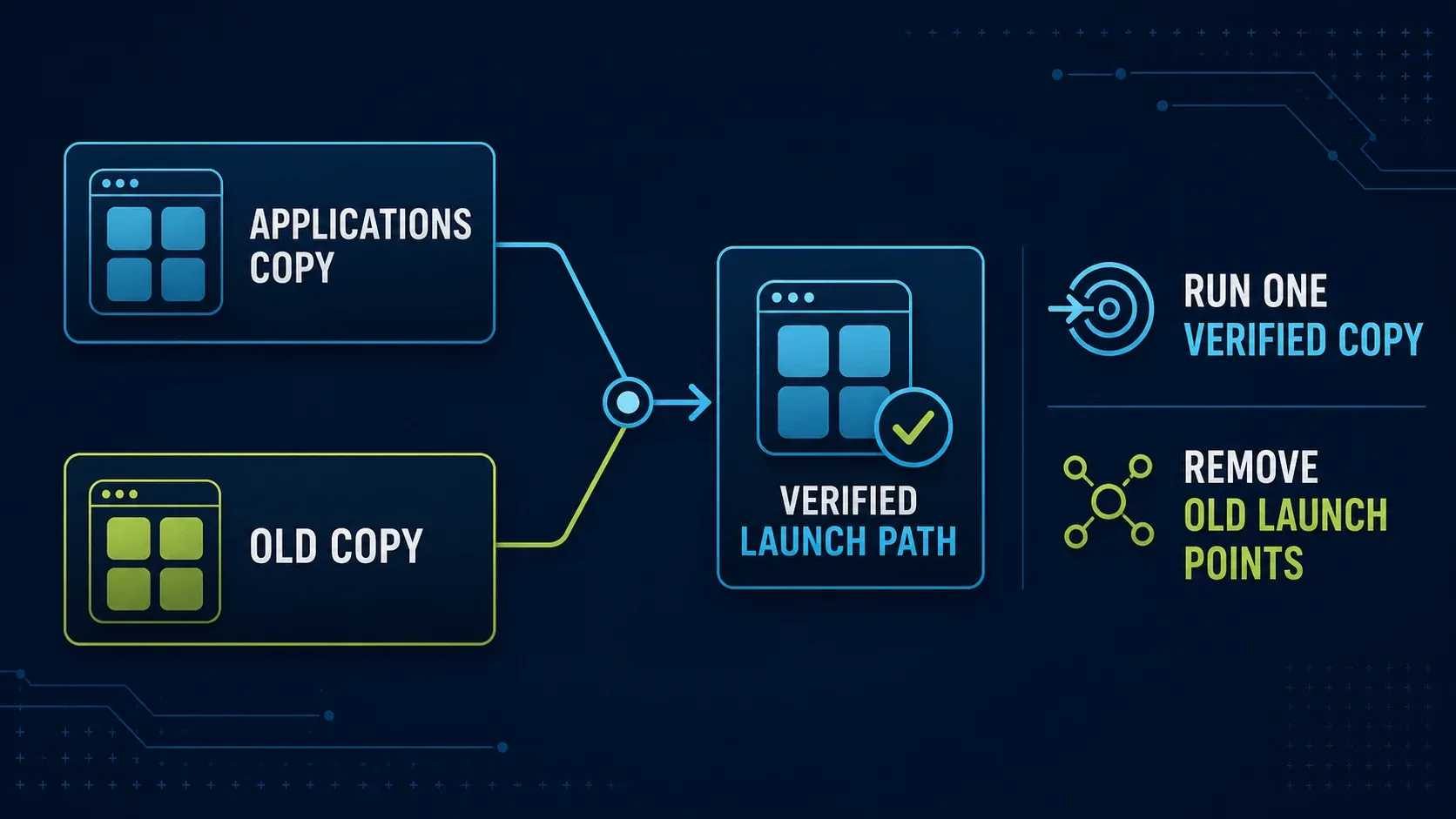
Verify which app you are launching if the approved entry and running version do not agree. An old Dock shortcut or a second installed copy can send you to a different release. This is a possibility to check, not the assumed cause of every reverting switch.
- Save open captures, stop recording and quit Snagit normally.
- Locate the intended installed app in Applications.
- Launch that copy and read its version under Snagit > About Snagit.
- Check whether the Dock shortcut or login item launches a different copy. Correct only an entry you have identified.
- Use Fix Capture Permissions from that verified copy and retest.
Do not delete the Library, captures or an older installation as a diagnostic shortcut. Back up valuable source files before changing installations. The install and update guide covers supported releases and update routes.
Use the official Support Tool only after scoped checks
The Support Tool exists in website editions from 2022.1.0, not App Store editions. With Snagit active, open Help > Support Tool.
Reset System Permissions resets Snagit’s screen, microphone and webcam access. Save work before restarting the Mac, then reopen Snagit and review fresh requests. Involve IT first on managed Macs.
Reset All Preferences changes the toolbar, capture settings, stamps and Library location. If support recommends it, use Create Preferences Archive first and keep Snagit_Data.zip privately. Back up captures separately.
TechSmith says this preferences reset retains themes, favourites and captures. Restoring preferences can restore the fault. Do not post the archive publicly.
If your edition has no Support Tool, use the permission panel and collect a reproducible case for TechSmith. Do not substitute a broad Terminal reset, edit the privacy database or weaken system security. Older forum commands may name an entirely different app bundle.
Stop and contact IT on a managed Mac
A locked or reverting permission can be controlled by management, but the symptom alone does not prove that. Apple’s Privacy Preferences Policy Control documentation distinguishes controls by service: its camera and microphone entries describe denial, while Accessibility can be authorised. Do not assume IT can silently grant every permission through the same policy.
Ask IT to check the installed app’s identity, the applicable policy and any user approval still required. Supply the failed task, macOS and Snagit versions, permission category and a redacted view of the locked control. Do not send a whole desktop full of private information.
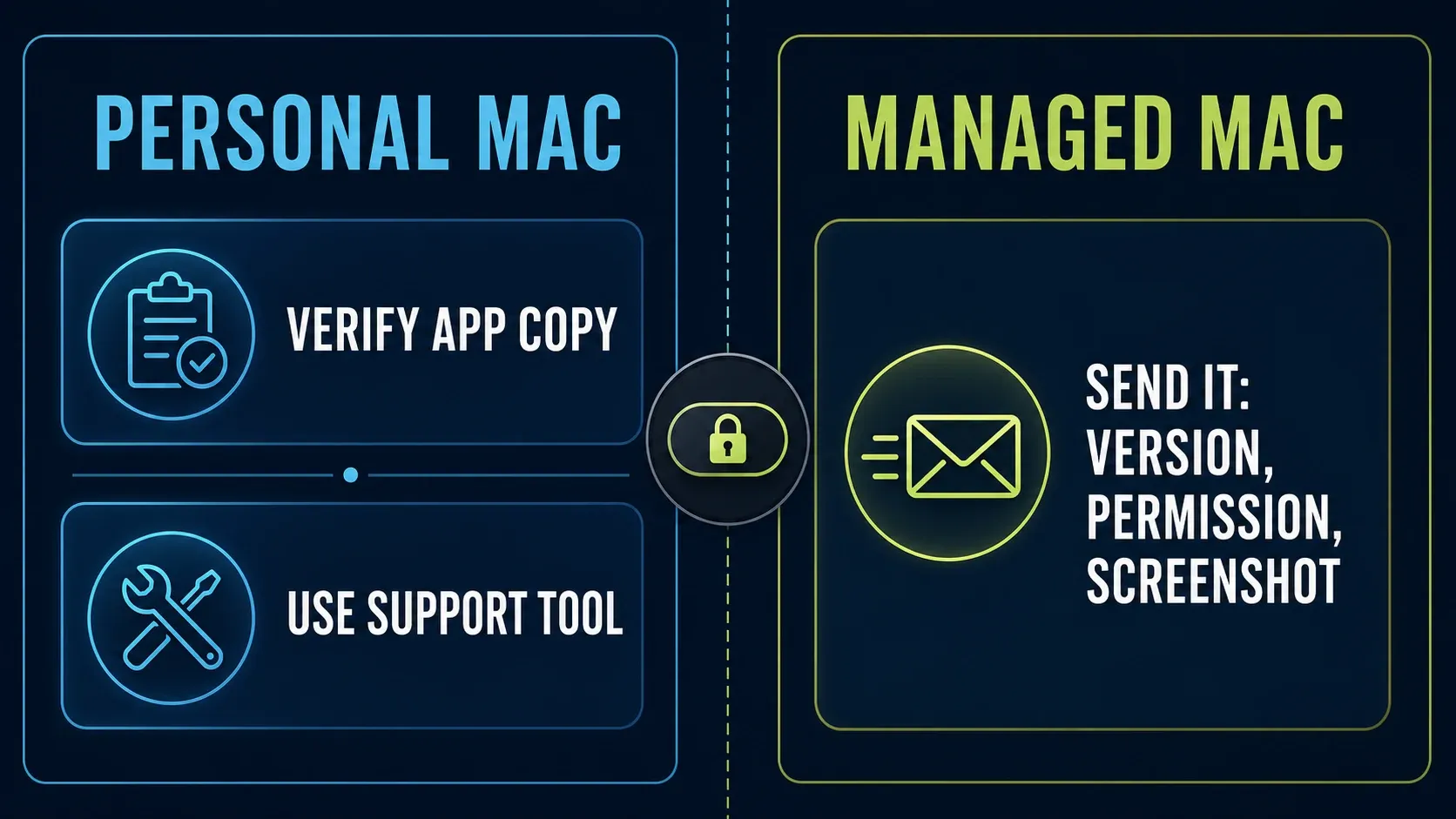
On a personal Mac, first verify the installed copy and the specific access it requests. On a managed Mac, let the administrator resolve the restriction. Do not install another copy or remove a management profile to get around it.
Keep the permission set as small as possible
Keep access tied to the task: screen access for screenshots, microphone for narration, camera for webcam video and Accessibility for Automatic Scrolling. A feature you do not use is not a reason to grant its permission. Screen access alone is not a reason to grant Full Disk Access.
You can review or revoke optional access in System Settings > Privacy & Security. The corresponding feature may stop working or request approval again. Retest before relying on it for a meeting or deadline.
Inspect the exported test before sharing it. Also review Snagit’s sharing actions and any synchronised destination folder: a local permission controls capture access, not where a later export or upload goes.
Build a support packet that leads to an answer
If the scoped checks fail, send the vendor a small reproducible case. Do not repeat resets simply because the first one did not help.
- Exact Snagit version and website or Mac App Store distribution.
- macOS point release and whether the Mac is managed.
- Failed task: screen, computer audio, microphone, camera or scrolling.
- Permission state: enabled, disabled, missing, locked or reverting.
- Harmless local test and its actual result.
- Recent software, device or management change.
- One redacted screenshot and the test time, if useful.
Check the current system requirements as well. Snagit 2026 lists Sequoia 15 and Tahoe 26, not Sonoma 14. Use the Mac compatibility guide to identify a supported app/OS combination before reinstalling or changing licences.
Snagit Mac permissions FAQ
Which permission does Snagit need to capture the screen?
Check Snagit in System Settings > Privacy & Security > Screen & System Audio Recording. Audio-only access does not grant screen capture. Save work, reopen Snagit after any required approval and test a plain local window. Older macOS versions may label the category Screen Recording.
Why can Snagit record the screen but not my voice?
Microphone access, the selected input and Snagit’s recording switch are separate checks. Allow Snagit in Privacy & Security > Microphone if appropriate, reopen it and select the intended input before recording a sentence.
Does Snagit need Accessibility permission on Mac?
Automatic Scrolling requires Accessibility for Snagit and SnagitHelper in TechSmith’s procedure. Do not grant every optional permission for a normal region capture. Enable access only for a trusted installed app and the feature you use.
Why is SnagitHelper listed in Accessibility?
The helper participates in Automatic Scrolling, for which TechSmith specifies both apps in Accessibility. Its older screen-recording instructions also mention the helper for Snagit 2022 and earlier. These are separate categories and version-specific instructions.
Do I need the old system audio component on macOS 13 or later?
Current supported Snagit uses native system audio on macOS 13 or later. For older releases, native support starts at 2022.2.3 and 2023.0.1; 2023.0.0 used the old workflow. Check the app version before following legacy extension instructions.
What should I do when a permission switch is locked?
Check whether management or another restriction applies and ask IT to review the installed app and policy. Do not remove profiles or bypass the restriction. Include versions, the failed task and a redacted image of the permission state.
How do I reset Snagit permissions safely?
Start with Fix Capture Permissions and the specific failed capability. If a reset is still appropriate, website editions from 2022.1.0 have Help > Support Tool > Reset System Permissions. Save work before restarting the Mac and approving fresh requests. This is different from Reset All Preferences.
If Snagit will not launch at all, use the Editor launch troubleshooting guide. For a different capture error, the Snagit troubleshooting hub routes you to the relevant checks.