
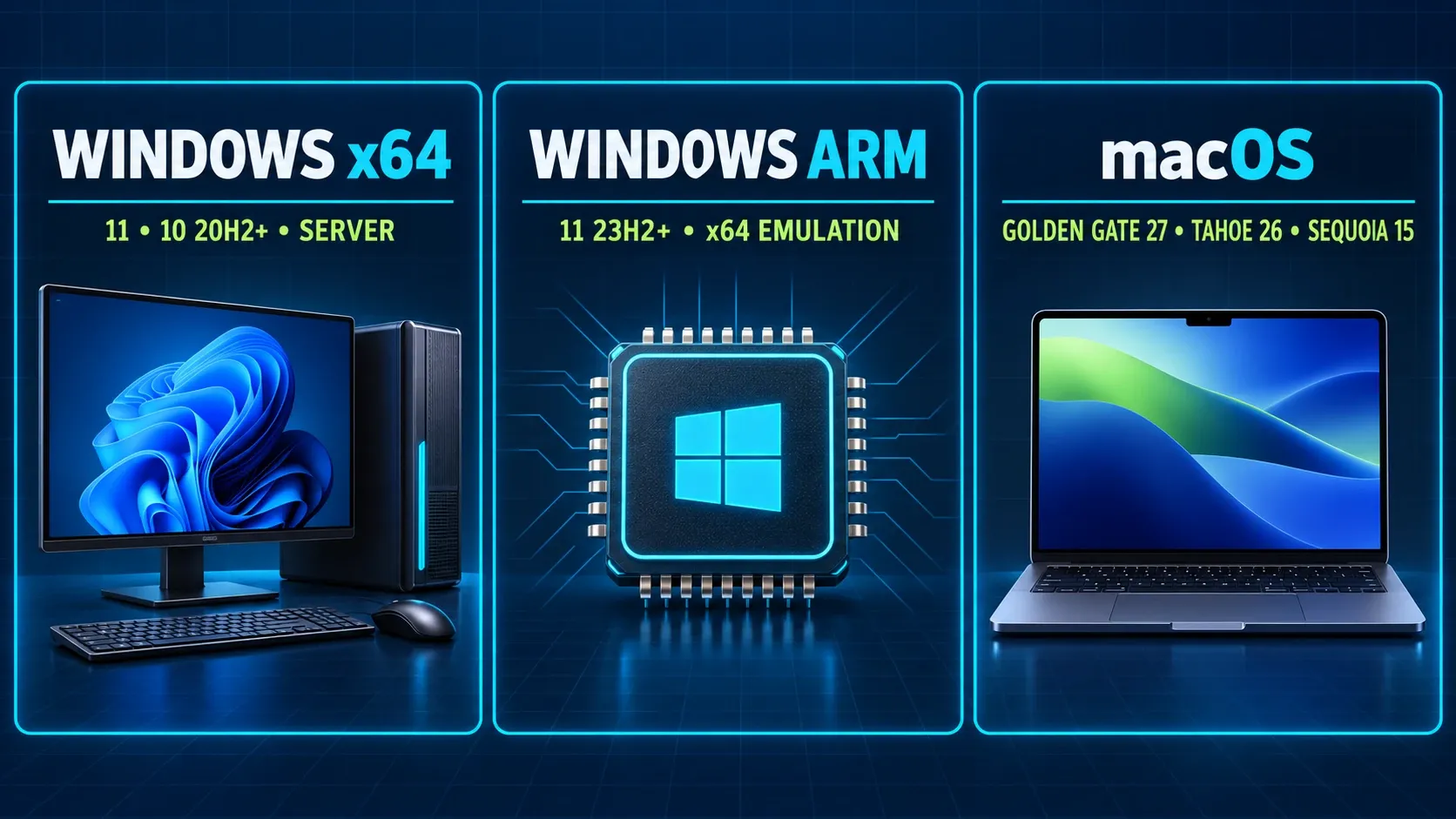
Snagit 2026 supports 64-bit Windows 11, Windows 10 20H2 or later, and Windows 11 on ARM 23H2 or later. Server 2016 and 2019 are listed; Server 2022 needs Snagit 2026.1.1 or newer. On Mac, the supported releases are Golden Gate 27, Tahoe 26, and Sequoia 15. The Windows baseline is an Intel i5 sixth-generation CPU or AMD equivalent, with 8 GB RAM recommended and 1.6 GB for installation. Video requires Intel eighth generation or Ryzen 2000 series or newer.
Snagit 2026 requirements at a glance
| Area | Current published requirement | Important limit |
|---|---|---|
| Windows x64 | 64-bit Windows 11; Windows 10 20H2+; Server 2016, 2019, or 2022 | Server 2022 needs Snagit 2026.1.1+; Windows N needs Media Feature Pack |
| Windows ARM | Windows 11 ARM 23H2+ | x64 emulation; Snagit Printer unavailable |
| Windows CPU | Intel i5 6th gen or AMD equivalent | Video needs Intel 8th gen+ or Ryzen 2000+ |
| Windows memory | 8 GB RAM recommended | Recommendation is not a workload guarantee |
| Windows storage | 1.6 GB for program installation | Library, video, exports, and backups need more |
| macOS | Golden Gate 27, Tahoe 26, or Sequoia 15 | Snagit 2026 does not support Sonoma 14 |
Windows also requires .NET Framework 4.7.2 or later and the Microsoft Edge WebView2 Runtime, which TechSmith includes with the installer. These are compatibility requirements, not a promise of smooth recording or capture at every resolution. The Mac section does not publish separate RAM or installation-space figures; do not treat the Windows numbers as Mac specifications.
If your device falls outside the table, choose a supported Snagit and OS combination before installing. You may need an older compatible release, an approved OS update or another device. The Snagit install and update guide explains how your subscription or perpetual key affects the installer you can activate.
Resolve conflicting requirements before choosing a build
The live Snagit requirements page supplies the main matrix above. A separate support summary dated December 5, 2025 still lists ARM 22H2, Windows 10 1903 and Sonoma. Search snippets can also retain those older values. They do not override the release-specific requirements.
Check the current matrix together with the release history and exact OS compatibility row. For example, the Windows table adds a minimum Snagit build for Server 2022, while the Mac 2026 notes explicitly exclude Sonoma. Do not combine the least restrictive values from different pages. Record the source URLs and check date for a deployment decision.
Windows 11, Windows 10, and Windows Server
For a new Windows workstation, use a supported Windows 11 release where your hardware and organization allow it. Snagit listing Windows 10 20H2 or later does not extend Windows security support. Microsoft's Windows release-health page records the end of ordinary Windows 10 support on October 14, 2025. ESU enrollment and LTSC editions have separate lifecycle rules.
Server compatibility does not establish capacity for Remote Desktop Services, Citrix or another shared environment. Use the applicable virtualization documentation and test concurrent users, resolution, profile storage, Library location, security software and sharing. Do not estimate a validated server design by multiplying the single-user 8 GB recommendation by the number of sessions.
The Windows compatibility table specifies Snagit 2026.1.1 or later for Server 2022. It also maps older Windows releases to Snagit branches. Check the current major's requirements and your activation entitlement as well as that table; an older row marked "or later" is not permission to ignore a newer release's restrictions.
Windows ARM is supported through emulation
TechSmith's ARM compatibility note describes x64 emulation, not a native Windows ARM build. The current requirements set Windows 11 ARM 23H2 as the OS minimum. Snagit Printer is unavailable on ARM.
Test your required region capture, scrolling, OCR, audio, video and sharing tasks on the exact ARM device. Compatibility alone does not establish performance on every model. If Snagit Printer is essential, use a supported x64 system.
Windows N needs media components
Windows N can prevent Snagit installation until the required media components are present. TechSmith's Media Feature Pack instructions call for the pack matching your Windows edition. Save work, install it through the approved route, restart, then retry installation or the failed recording. Ask IT to handle managed-device changes.
A missing media pack and a wrong microphone are two different failures. If image capture works while audio or video fails, note the Windows edition and installed optional features first. Then walk through the Snagit audio troubleshooting workflow to separate system components, device selection, permissions, and application conflicts.
Windows hardware baseline and video requirement
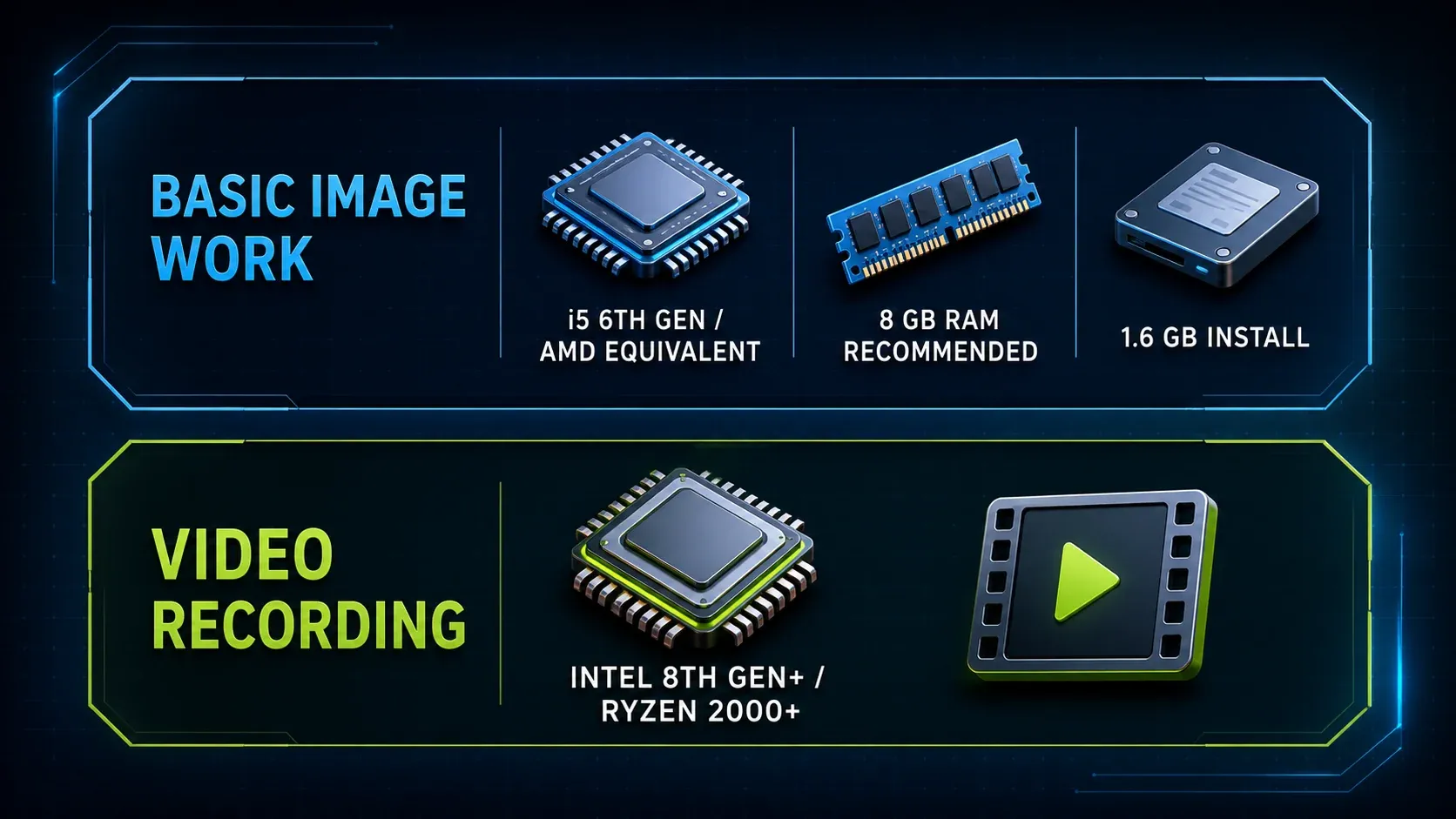
The Windows CPU requirement distinguishes image work from video. An Intel i5 sixth-generation processor or AMD equivalent meets the published general baseline; recording calls for Intel eighth generation or newer, or Ryzen 2000 series or newer. A machine can meet the image requirement without meeting the video requirement.
The 8 GB RAM recommendation is for Windows. Compare it with the memory your browser, meetings, security software and open Editor files use during normal work. More memory may help when capacity is the constraint; it does not fix every capture error.
macOS Golden Gate, Tahoe, Sequoia, Sonoma, and Apple silicon
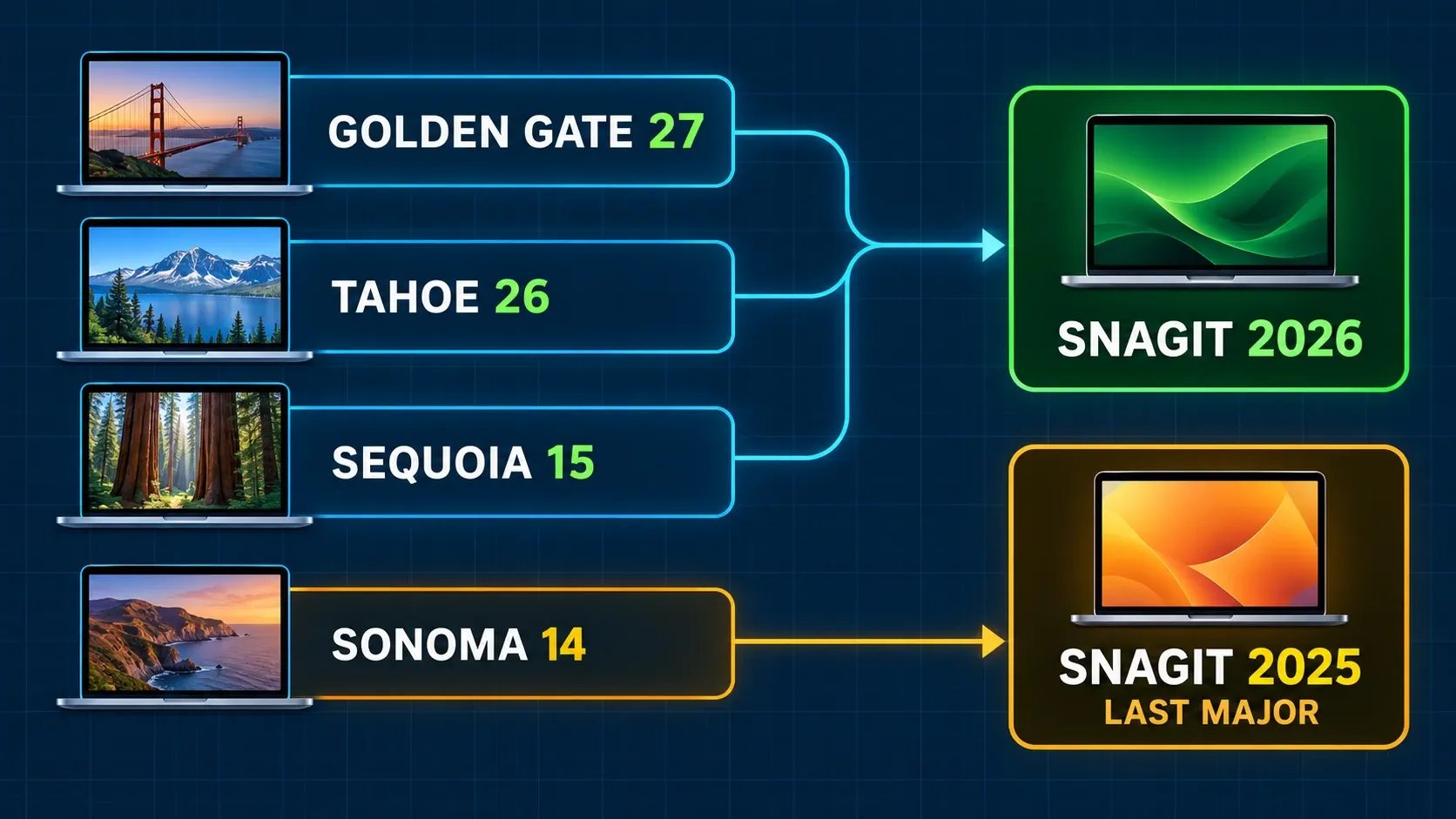
The live page lists Golden Gate 27, Tahoe 26, and Sequoia 15 for Snagit 2026. The Mac 2026 version history says Sonoma 14 is not supported, and it names Snagit 2025 as the last major release for Sonoma. So a Mac limited to Sonoma needs a compatible 2025 build, not the 2026 installer.
Use the macOS compatibility table for older combinations. Check the exact Snagit build, macOS release and activation entitlement separately. The Snagit for Mac guide covers the platform's capture and editing workflow.
TechSmith documents Snagit Mac 2021.3.0 and later as a Universal application, with native Apple silicon support. An Intel Mac must still natively support the required macOS version.
TechSmith does not support Macs patched with third-party software to run an OS their hardware does not natively support. Its unsupported Mac environments note lists possible capture, video, system-audio and Editor-color failures. Successful launch does not make that configuration supported.
Grant the Mac permissions needed for your chosen task. Screen capture, microphone narration and camera recording have different permission needs; do not approve unrelated access. Use the Snagit Mac permissions checklist and restart when the approval prompt requires it.
Installation space is not Library capacity
The 1.6 GB figure covers Windows program installation and nothing else. It doesn't include the Snagit Library, editable SNAGX files, scrolling captures, GIFs, videos, exports, backups, or temporary working space. A short image workflow and daily screen recording produce very different storage needs.
Measure a representative week of Library growth and keep room for your largest source file, recordings, backup and restore work. This is a planning estimate, not a fixed capacity guarantee. Leave the OS free space for updates and temporary files. The Library backup guide covers supported locations and recovery.
High-DPI and multi-monitor work needs a real test
TechSmith's Windows capture-performance guidance describes two to three 1080p monitors, or up to two 4K monitors at 60 Hz or below. It does not guarantee every combination of GPU, dock, HDR and scaling settings. Treat the display setup as part of your test.
Capture each display and make a short test recording. Inspect dimensions, text, colors, cursor position and the intended audio. If selection, mixed scaling, slow crosshairs or HDR output fails, use the multi-monitor capture checks to investigate one condition at a time. Record which setup fails before changing settings.
Translate the matrix into your workflow
Occasional screenshots and light markup
Try an ordinary work session with your browser, meeting software and security tools open. Capture a typical region, add the notes you need and save it. This checks your workload more usefully than launching Snagit on an otherwise empty desktop.
Open the export at its intended destination size and inspect the text. A successful launch does not validate capture selection or output scaling. For the basic sequence, follow the capture, edit and share tutorial.
Documentation with long captures and editable sources
Long captures, open SNAGX sources, templates, OCR, and a growing Library all ask for more memory and storage, and the 1.6 GB installation number doesn't plan for any of that. Capture a typical long page and add your notes. Save the editable source, export the final image, and measure how much the Library and backup grew.
Include version history and restore space in your storage plan. Use a Library location supported for your Snagit release and test its backup procedure. Do not assume an arbitrary network or cloud-synced folder behaves like local storage.
Screen recording on high-resolution displays
Start with the video CPU requirement, then test the region, resolution, duration and audio sources you intend to use. For example, record five to ten minutes of typical material and play the whole clip to check audio sync and image quality. Choose a longer test for a longer job.
A faster processor does not repair missing media components, denied permissions or every application conflict. Record the exact failed task and error before buying hardware or reinstalling. Keep private content out of diagnostic samples.
Managed Windows or Mac rollout
For a managed rollout, validate the installer, license, activation route, proxy rules, update policy, account permissions, security controls, Library location and sharing destinations. Confirm how to restore the previous approved configuration before deploying broadly.
Run a small pilot with the same user permissions and policies production will use. A local administrator test can hide permission and storage failures that hit a standard employee. Write down the approved Snagit build and operating-system build so a later update can be compared against a known working state.
Internet, activation, and unsupported platforms
TechSmith's deployment guidance says subscription applications normally need internet access for activation and at least every 90 days to verify the license. Cloud features also need connectivity. Documented Business and offline configurations have separate conditions; they are not an automatic promise of unlimited disconnected use. The offline activation guide explains those routes.
Linux and ChromeOS are not listed as supported Snagit desktop platforms. TechSmith does document some Windows virtualization routes, but that does not validate every virtual machine or compatibility layer. Use the relevant deployment guide for your environment. For release-specific changes, consult the Snagit 2026 update guide.
Compatibility preflight
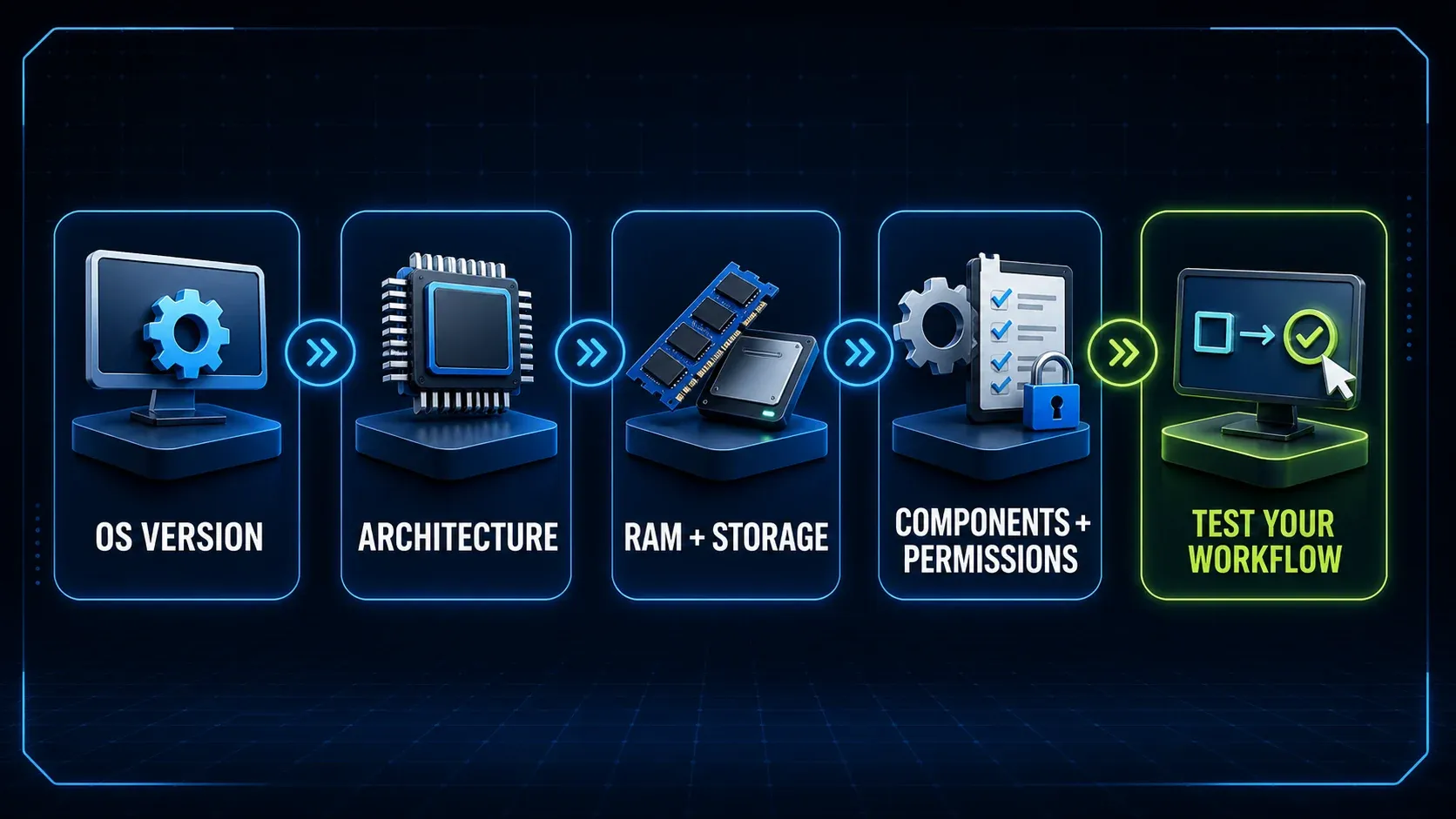
Record the exact operating system
Write down the edition, version, and build. A name such as Windows 11 or macOS alone is not enough for an ARM or old-version decision.
Confirm the processor architecture
Separate Windows x64, Windows ARM, Intel Mac, and Apple silicon before checking feature limits or deployment packages.
Check hardware and free space
Compare the published processor, memory, and installation figures, then allow separate capacity for the Library, recordings, and active applications.
Verify components and permissions
Check Windows media components or Mac privacy permissions before treating a failed capture as a hardware problem.
Test the real workflow
Run each task on the exact device before a purchase or team rollout. Include region and scrolling capture, audio, video, displays, storage, and sharing.
On a personal computer, start with a typical image, scrolling capture and short recording. For a team, repeat the preflight with the production package, standard-user permissions, network rules, Library path and sharing destinations. Save the results so you can compare them after an update.
Snagit 2026 system requirements FAQ
Does Snagit 2026 work on Windows 11?
Yes. TechSmith lists 64-bit Windows 11. Windows 11 on ARM needs version 23H2 or later, runs Snagit through x64 emulation, and does not support the Snagit Printer.
Does Snagit 2026 still work on Windows 10?
TechSmith's live requirements page lists 64-bit Windows 10 20H2 or later. That is application compatibility, not a Windows lifecycle recommendation. Ordinary Windows 10 support ended on October 14, 2025; ESU and LTSC have separate rules.
Which macOS versions support Snagit 2026?
TechSmith's live page lists macOS Golden Gate 27, Tahoe 26, and Sequoia 15. The Snagit Mac 2026 release history says Sonoma 14 is not supported and Snagit 2025 is the last major release for Sonoma.
How much RAM does Snagit 2026 need?
TechSmith recommends 8 GB of RAM on Windows. It does not promise that 8 GB will be comfortable for long scrolling captures, large Libraries, high-resolution video, and heavy multitasking. Test the actual workload.
Can Snagit run on an Apple silicon Mac?
Yes. TechSmith says Snagit Mac 2021.3.0 and later is a Universal application with native Apple silicon support. The Mac must also run a macOS version supported by the Snagit release.
Can Snagit run on Linux or Chromebook?
TechSmith does not list Linux or ChromeOS as supported desktop platforms for Snagit. A virtual machine or compatibility layer does not become a supported configuration unless TechSmith documents it.
Does Snagit need an internet connection?
Subscription applications normally need internet access for activation and license verification at least every 90 days. Cloud features also need connectivity. TechSmith documents separate Business and offline configurations; check their conditions rather than assuming unlimited offline use.
Is 1.6 GB of free space enough for Snagit?
The 1.6 GB figure is for Windows program installation. Your Snagit Library, editable SNAGX files, scrolling captures, GIFs, videos, exports, backups, and temporary working space require additional storage.